For nine seasons, Michael Landon played one of television’s most beloved fathers: Charles “Pa” Ingalls.
The Charles Ingalls depicted in Little House on the Prairie worked tirelessly for his family. He forgave his enemies, raised his daughters with patience, confronted injustice, and almost always put the people he loved ahead of himself.
Generations of viewers came to see him as the ideal American father.
But how closely did Landon’s character resemble the real Charles Ingalls?
The historical record reveals a considerably more complicated man—and a family story marked by displacement, debt, poverty, prejudice, and instability. Michael Landon did not invent everything audiences loved about the Ingalls family, but his series removed many of the details that made their real lives difficult and morally uncomfortable.
With Netflix’s new Little House on the Prairie adaptation now streaming, it is worth revisiting the true story behind America’s favorite frontier family.
Michael Landon’s Charles Ingalls Was a Carefully Constructed Myth
The original NBC series was never intended to be a documentary. It adapted Laura Ingalls Wilder’s semi-autobiographical books, which had already reshaped her family’s history for young readers.
Michael Landon took that transformation even further.
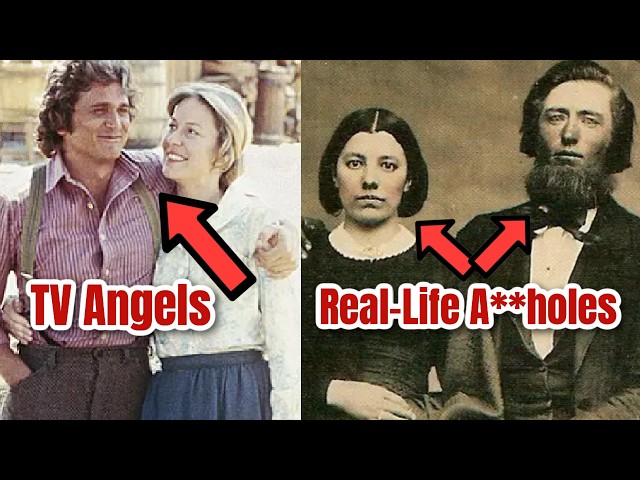
His Charles Ingalls was handsome, charismatic, and dependable. Although the television family faced floods, fires, failed harvests, and financial hardship, Pa remained its moral center. His judgment could be questioned, but his devotion rarely was.
The real Charles Ingalls was more restless and less reliable. His repeated pursuit of a better life subjected his wife and children to years of uncertainty. Some of his decisions also reflected the injustices and prejudices underlying westward expansion.
That does not make him a one-dimensional villain. It does mean that the familiar television character tells only a small—and highly polished—part of the story.
The Ingalls Family Settled on Osage Land
One of the most troubling episodes in the Ingalls family story occurred in Kansas.
Charles moved his family onto land that still legally belonged to the Osage Nation. He never filed a homestead claim there because the land was not open to white settlement. Instead, he appears to have acted on reports that the federal government would eventually remove the Osage people.
In Little House on the Prairie, Laura wrote that her father would not have crossed into Indian Territory without receiving word that settlers would be allowed to remain. The family was effectively gambling that the government would force the Osage from their home.
The logs used to construct the family’s cabin were also taken from Osage land. Laura Ingalls Wilder biographer Caroline Fraser has characterized that act plainly as theft.
These circumstances complicate the comforting image of Pa building an honest life from untouched wilderness. The land was not empty, and its resources did not belong to him.
Charles and Caroline Ingalls Shared the Prejudices of Their Time
The Ingalls family’s attitudes toward Native Americans were also far less compassionate than television audiences might expect.
In Wilder’s book, Caroline “Ma” Ingalls openly expresses fear and hostility toward the Osage. She refers to Native people as “devils” and tells Laura she does not like them.
Charles occasionally appears more curious or tolerant, but his views were hardly enlightened. At one point, he speculates that conflict between Native nations might remove the people standing between settlers and the land they wanted.
These passages show a household participating in—and attempting to benefit from—the displacement of Native Americans.
Historical context can help explain such beliefs, but it does not erase their consequences. The Ingalls family’s prairie story unfolded within a much larger campaign of dispossession.
Charles Ingalls Could Never Stop Moving
On television, Charles establishes a home and becomes a dependable member of his community. The real man had what he reportedly called a “wandering foot.”
The family moved from Wisconsin to Kansas, returned to Wisconsin, continued to Minnesota, relocated to Iowa, went back to Minnesota, and eventually settled in Dakota Territory.
Some of these moves were responses to genuine disasters. A devastating grasshopper infestation destroyed crops in Minnesota during the 1870s, eliminating the family’s livelihood. Their nine-month-old son, Charles Frederick Ingalls, also died during this turbulent period.
Other decisions were driven by Charles’ recurring hope that the next opportunity would finally deliver prosperity.
Seen generously, he was an optimist who refused to surrender. Seen more critically, he repeatedly gambled his family’s security on uncertain plans.
Either interpretation is far removed from the stable patriarch portrayed by Michael Landon.
The Ingalls Family’s Difficult Years in Iowa
The family moved to Burr Oak, Iowa, after Charles became involved in a hotel venture. The arrangement did not provide the fresh start he had imagined.
The Ingalls family lived in cramped quarters at the Masters Hotel, where Caroline cooked and Mary and Laura helped serve guests. Charles briefly worked at a gristmill, while the family lived beside a saloon and endured conditions unlike the wholesome domestic setting associated with the television series.
Eventually, they moved into rooms above a nearby grocery store.
This period reveals another side of Caroline Ingalls. The television version of Ma, played by Karen Grassle, was gentle, patient, and often positioned behind her husband. The real Caroline performed punishing physical labor and put her daughters to work beside her.
She also exerted more influence over the family’s decisions than the series suggests. According to material associated with Laura’s original memoir, Pioneer Girl, Caroline eventually resisted another proposed move after Charles became interested in an uncertain opportunity in Oregon.
Charles and Caroline Left Town Without Paying Their Debts
One of the most startling stories in Pioneer Girl concerns the family’s unpaid bills.
Facing medical expenses, rent, and grocery debts, Charles reportedly asked a landlord for more time. When the request was refused and the family’s horses were threatened, Charles and Caroline loaded their wagon at night, awakened their children, and left town without settling what they owed.
It is difficult to imagine Michael Landon’s Pa Ingalls doing the same.
The incident illustrates the depth of the family’s financial desperation. It also challenges the idea that Charles always met hardship with unimpeachable honesty.
By the time the family reached Burr Oak, its poverty was visible enough that a prosperous neighbor made Caroline an extraordinary offer.
A Neighbor Offered to Adopt Laura
Eunice Starr, the wife of a local doctor, reportedly offered to adopt nine-year-old Laura.
Caroline refused, saying she could not “spare” her daughter.
The word takes on added significance because Laura was already being sent to work for other families. She cooked, cleaned, and cared for children, with her earnings helping support the Ingalls household.
Laura was still a child, but she had become an economic contributor. Losing her would have meant losing both a daughter and a valuable source of income.
Child labor was common in the 19th century, especially among struggling families. Even so, this part of Laura’s childhood bears little resemblance to the protected, idyllic life many viewers associate with Walnut Grove.
Mary Ingalls Probably Was Not Blinded by Scarlet Fever
Mary’s blindness became one of the original television show’s most memorable storylines. The customary explanation was that scarlet fever caused her to lose her sight.
Modern researchers have challenged that diagnosis.
A team led by a University of Michigan pediatrician examined the surviving evidence and concluded that viral meningoencephalitis was a more likely cause. Historical records described Mary as suffering from “brain fever,” while a contemporary report noted partial facial paralysis—symptoms inconsistent with the familiar scarlet-fever explanation.
Laura herself appeared uncertain. In a 1937 letter, she initially referred to spinal meningitis before changing the wording to a less definite “spinal sickness.”
The simplified diagnosis is another example of a complex family experience becoming cleaner and more conclusive through repeated retelling.
Carrie Ingalls Lived a Remarkably Independent Life
Carrie Ingalls received little character development on Michael Landon’s series. The real Carrie, however, grew into an accomplished and independent woman.
She learned the printing trade and worked as a typesetter before becoming involved with newspapers in South Dakota. She eventually edited the Hill City Star and worked in several Black Hills communities.
Around 1907, Carrie also filed her own homestead claim. To meet its requirements, she lived alone for part of each year in a tar-paper shanty near the Badlands.
Her career and frontier independence would have made a compelling television story. Instead, the original show left most viewers knowing almost nothing about her adult life.
Laura and Almanzo’s Courtship Was Revised
Laura’s marriage to Almanzo Wilder also underwent some careful editing.
When the pair married in 1885, Laura was 18 and Almanzo was approximately 28. Their courtship had begun while Laura was a teenage schoolteacher and Almanzo was driving her home during the harsh Dakota winters.
A 10-year age difference was not necessarily considered scandalous in that time and place. It could, however, make later generations of young readers uncomfortable. Scholars have suggested that Laura adjusted ages and chronology when adapting her life for children.
Almanzo’s age also raises questions about his homestead claim. If he was under 21 when he filed, as Laura’s account suggests, he would not have been legally eligible to claim the land.
The surviving records do not agree consistently about his age, leaving a mystery that has never been completely resolved.
Several Beloved Ingalls Children Were Entirely Fictional
The television family eventually adopted Albert, James, and Cassandra.
None of these children belonged to the historical Ingalls household or appeared in Wilder’s original books. They were created for television as the series expanded beyond its source material.
Their inclusion altered the family in a particularly revealing way. During its most difficult years, the real Ingalls household struggled to feed and support its own children. The generous family that repeatedly opened its home to orphans was largely a television invention.
Was the Real Ingalls Family Deeply Religious?
Michael Landon’s Little House on the Prairie presented the Ingalls family as openly and consistently Christian. Prayer, Scripture, and church attendance served as central features of family life.
Historian John J. Fry’s research into Laura Ingalls Wilder’s religious life paints a subtler picture. Christianity mattered to Wilder, but she generally kept her beliefs private. She rarely maintained formal church membership and did not consistently place religion at the center of her writing.
The family’s on-screen devotion therefore appears to reflect Landon’s storytelling priorities at least as much as the historical record.
How Netflix’s Little House on the Prairie Could Change the Story
Netflix’s new Little House on the Prairie premiered on July 9, 2026. The eight-episode first season follows the Ingalls family’s journey from Wisconsin to Kansas and is based primarily on the third book in Wilder’s series.
Netflix describes the adaptation as part family drama, part survival story, and part examination of the American West. That approach creates room for a more honest depiction of the Osage Nation and the realities surrounding white settlement.
The question is how far the adaptation is prepared to go.
It is one thing to make frontier life look difficult. It is another to show a beloved father knowingly settling on land that was not his, parents fleeing their debts, or a household so poor that a neighbor offered to adopt one of its children.
Michael Landon made the Ingalls family easy to admire by removing many of these complications. A genuinely fresh adaptation has the opportunity to restore them.
The Truth Is More Complicated Than the Television Legend
The real Ingalls family endured disease, grief, crop failures, poverty, and relentless physical labor. Their perseverance was genuine, but so were their mistakes and prejudices.
Charles Ingalls could be loving and hopeful while also being reckless. Caroline could be hardworking and strong while sharing deeply harmful attitudes toward Native Americans. Laura could treasure her family while revising its history for readers.
Acknowledging those contradictions does not destroy the Little House story. It replaces a comfortable legend with something more recognizably human.
The family behind Little House on the Prairie was never as simple as Michael Landon’s television version suggested. Whether Netflix will fully confront that difficult history remains one of the most intriguing questions surrounding its new adaptation.