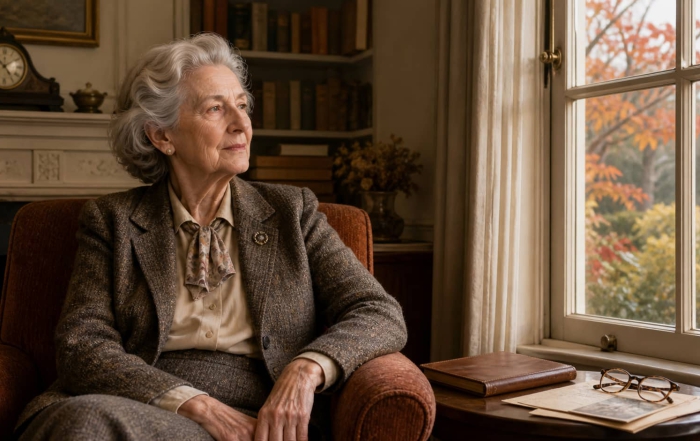
Rose Wilder Lane (December 5, 1886 – October 30, 1968) was an American writer and the daughter of Laura Ingalls Wilder, author of the “Little House” books. Alongside Ayn Rand and Isabel Paterson, Lane was one of the most influential advocates of the American libertarian movement.
Early Life
Rose Wilder Lane was born at the Wilder homestead in De Smet, South Dakota. She was the first child of Laura Ingalls Wilder and Almanzo Wilder and the only one to survive into adulthood. Her early childhood was marked by hardship due to crop failures, illnesses, and economic difficulties faced by her parents. The family moved frequently, living with relatives in Minnesota and Florida, briefly returning to De Smet, and settling in Mansfield, Missouri, in 1894. There, her parents established a dairy farm and fruit orchards. Lane attended secondary school in Mansfield and Crowley, Louisiana, while living with her aunt, Eliza Jane Wilder. She graduated in 1904, demonstrating her intellectual capabilities by compressing three years of Latin into one and graduating at the top of her class. Despite her academic success, she could not attend college due to her family’s financial constraints.
Early Career, Marriage, and Divorce
After high school, Lane returned to her parents’ home in Mansfield and learned telegraphy at the local railroad station. Dissatisfied with the limited career opportunities available to young women in Mansfield, she began working for Western Union in Sedalia, Missouri, in early 1905. By 1906, she was a telegrapher at the Midland Hotel in Kansas City, Missouri. Over the next five years, Lane worked as a telegrapher in various locations, including Missouri, Indiana, and California.
In 1908, Lane moved to San Francisco, where she continued her work as a telegrapher at the Fairmont Hotel. In March 1909, she married Claire Gillette Lane, a salesman and occasional newspaperman. The couple may have met in Kansas City, and Lane’s diary suggests she moved to San Francisco to be with her future husband. Lane left her job at Western Union shortly after their marriage, and the couple traveled across the United States, promoting various schemes. Lane became pregnant but gave birth to a premature, stillborn son in Salt Lake City in November 1909. A subsequent surgery in Kansas City likely left her unable to have more children. The topic is briefly mentioned in a few letters she wrote years later, expressing sympathy to friends who had also lost children.
The Lanes led a nomadic lifestyle for several years, moving between Missouri, Ohio, New York, and Maine to work on promotional and advertising projects. Although Lane’s letters to her parents painted a picture of a carefree existence, her diaries and later autobiographical articles reveal she was often depressed and disillusioned with her marriage. She felt intellectually unfulfilled in her life with her husband and even attempted suicide at one point. During these years, Lane read extensively and taught herself several languages, driven by her awareness of her lack of formal education. Her writing career began around 1908, with occasional freelance newspaper jobs that provided much-needed income. In 1913 and 1914, the Lanes sold farmland in Northern California’s San Jose/Silicon Valley area. Lane was the more successful salesperson, often working separately from her husband. Eventually, the couple separated, and their marriage ended in an amicable divorce. Lane had several romantic relationships after her divorce but never remarried, choosing to remain single and independent.
The impending entry of the United States into World War I led to a weakened real estate market, prompting Lane to accept a job as an editorial assistant at the San Francisco Bulletin in early 1915. This job marked a turning point in her career. Lane quickly gained the attention of her editors through her writing and editing skills. Her photo and byline appeared regularly in the newspaper, and she wrote serialized romantic fiction and first-hand accounts of prominent figures like Henry Ford, Charlie Chaplin, Jack London, and Herbert Hoover, later published in book form.
Freelance Writing Career
By 1918, Lane’s marriage was officially over, and she left her job at the San Francisco Bulletin after the managing editor resigned. She then launched her freelance writing career, appearing in major publications such as Harper’s, Saturday Evening Post, Sunset, Good Housekeeping, and Ladies’ Home Journal. Several of her short stories were nominated for O. Henry Prizes, and her novels became bestsellers.
Lane became Herbert Hoover’s first biographer, co-writing The Making of Herbert Hoover in 1920 with Charles K. Field, the editor of Sunset magazine. This biography was published before Hoover became President in 1929. Lane remained a friend and defender of Hoover throughout her life, and her papers are now part of the Rose Wilder-Lane Collection at the Herbert Hoover Library in West Branch, Iowa.
In the late 1920s, Lane was considered one of the highest-paid female writers in America. Despite her financial success, her generosity often left her short of cash, forcing her to take on work that did not interest her. She also suffered from periodic bouts of self-doubt and depression, diagnosing herself with bipolar disorder. During these periods, she struggled to write her material but found work as a ghostwriter or editor for other authors. In 1928, Lane returned to her parents’ farm in Missouri, confident in her income from book sales and stock market investments. She built a new home for her parents on the property and modernized the farmhouse for herself and her literary friends, who often visited.
Travel and War Correspondence
Lane’s work as a war correspondent began with the American Red Cross Publicity Bureau in post-World War I Europe. She continued with the Red Cross until 1965, reporting from Vietnam at age 78 for Woman’s Day magazine to provide a “woman’s point of view.” She traveled extensively in Europe and Asia during her time with the Red Cross. In 1926, Lane, Helen Dore Boylston, and their French maid traveled from France to Albania in a car they named Zenobia. An account of their journey, Travels With Zenobia: Paris to Albania by Model T Ford, was published in 1983. Lane became enamored with Albania, living there for extended periods during the 1920s, and informally adopted a young Albanian boy named Rexh Meta, who she later sponsored to study at Cambridge University. Meta eventually served in the Albanian government and was imprisoned by both Italian fascists and Albanian communists, dying in 1985.
Literary Collaboration
Lane’s role in her mother’s “Little House” series remains a topic of debate among literary historians. In late 1930, her mother approached her with a rough manuscript, Pioneer Girl, which recounted her pioneer childhood. Despite Lane’s efforts to market the manuscript, publishers repeatedly rejected it. However, one editor suggested turning it into a children’s novel, which led to the creation of Little House in the Big Woods. Published by Harper and Brothers in 1932, the book’s success led to the continuation of the series, following Laura into young adulthood. Lane’s literary career also benefited from this collaboration, with her most famous short stories and novels being written during this period, drawing heavily on her mother’s recollections of family folklore.
Return to Journalism and Societal Views
During World War II, Lane enjoyed a resurgence in her writing career. From 1942 to 1945, she wrote a weekly column for The Pittsburgh Courier, the most widely-read African-American newspaper. In her columns, Lane combined her advocacy for laissez-faire economics with anti-racism, drawing parallels between racial discrimination and class distinctions.
Lane’s libertarian views became more pronounced during this period. She was critical of Franklin D. Roosevelt’s New Deal and opposed wartime rationing, taxation, and the draft. 1943, she publicly criticized the Social Security system, likening it to a Ponzi scheme. This led to a visit from a Connecticut State Trooper, which further fueled her disdain for government overreach. Her pamphlet, “What is this, the Gestapo?” was widely circulated, although its association with an anti-Semitic organization brought some controversy.
Later Years and Death
In her later years, Lane played an active role in the libertarian movement. She corresponded with prominent figures such as Ayn Rand and Frank Meyer and supported libertarian causes financially. After her mother died in 1957, Lane used the royalties from the “Little House” books to renovate her home in Connecticut and travel extensively. She continued writing, contributing to magazines, and revising The Discovery of Freedom.
Lane also became a mentor and adoptive grandmother to Roger Lea MacBride, who would later become the Libertarian Party’s presidential candidate in 1976 and the heir to the “Little House” franchise. She sponsored a young Vietnamese woman for college in the United States, further showcasing her belief in individual potential.
Rose Wilder Lane died in her sleep at age 81 on October 30, 1968, just before embarking on a three-year world tour. She is buried next to her parents in Mansfield Cemetery, Missouri.
In the Media
Rose Wilder Lane has been portrayed in various adaptations of “Little House on the Prairie,” including:
- Jennifer and Sarah E. Coleman (seasons 8-9) and Jennifer and Michele Steffin (post-series movies) in the Little House on the Prairie TV series.
- Terra Allen, Skye McCole Bartusiak, and Christina Stojanovich in the miniseries Beyond the Prairie: The True Story of Laura Ingalls Wilder.
Eight novels by Roger Lea MacBride tell of her childhood and early youth, though there is some debate over the authenticity of these accounts. Lane’s life has also been the subject of fictionalized accounts in novels such as Pioneer Girl by Bich Minh Nguyen and A Wilder Rose by Susan Wittig Albert. In the alternate history novel The Probability Broach by L. Neil Smith, Lane is depicted as the 21st president of the North American Confederacy.